

The first ten minutes matter more than the phone call
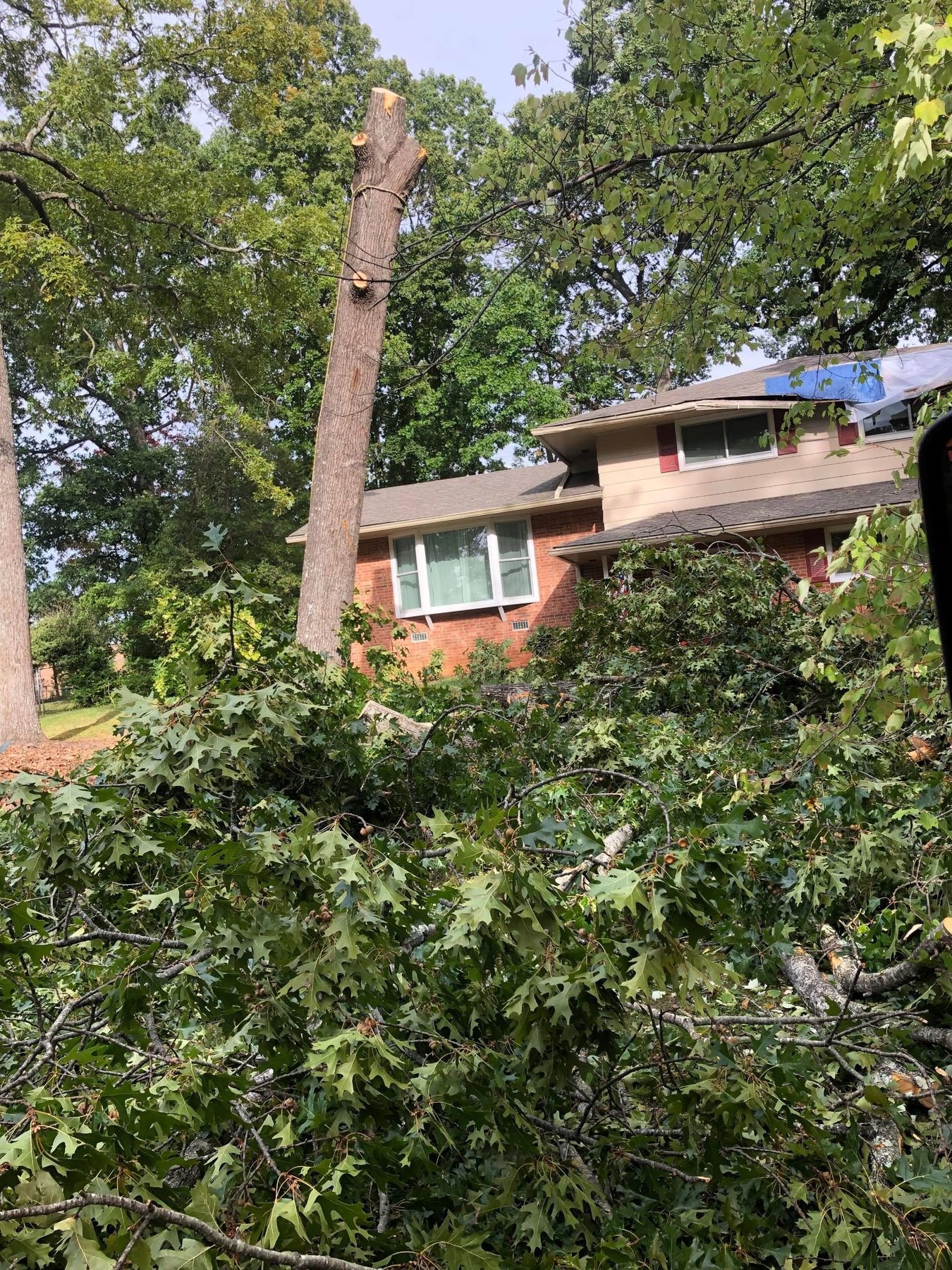
A tree has come down on your house, your car, or across the only way out. Before you call anybody about removing it, there are a few things worth doing in order.
Get everyone out from under it and stay out. A tree that has already fallen is still holding load, and so is everything it landed on. Roof structure that took the hit can let go later.
Call 911 if anyone is hurt, if you smell gas, or if there are wires down or sparking. That is a fire department call, not a tree company call, and it comes first.
If any part of the tree is touching a power line, call the utility and keep well back. Do not assume a line is dead because your power is out. Lines can re-energize without warning.
Photograph everything before anything moves. Wide shots and close shots, the tree, the damage, and the room underneath if you can get to it safely. Once the crew starts cutting, the scene is gone, and those photos are the only record of what it looked like.
Then call your insurance carrier, and call us. Those two can happen in either order, and on a bad night plenty of people call us first so the tree is on the schedule while they are still on hold.
On insurance, we will tell you what we know and not a word more. Whether a particular tree, a particular bit of damage, or the removal itself is covered is between you and your carrier, and it turns on your policy rather than on anything a tree company can tell you. What we can do is give you an itemized invoice and the photos we took on site, which is what adjusters usually ask for. The ISA's storm-damage guide and the NC Forest Service both cover the general ground.
What a storm call actually looks like.
Storm work goes to the front of the schedule, ahead of routine jobs that were booked first. That is the deal, and it is why routine work sometimes slips a day after a bad night across the Triad.
Trees hung up in other trees
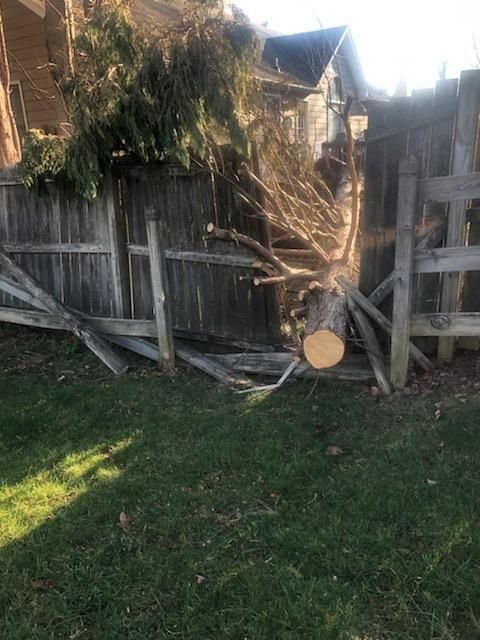
Of everything a storm leaves behind, this is the one that hurts people. A tree that has come part of the way down and is leaning into another tree is holding an enormous amount of stored energy in a position it was never built for.
It can release on its own, in a direction nobody predicts, hours or days later. Every year somebody is killed trying to free one with a chainsaw and a truck.
Keep people, cars, and pets out from under it and from anywhere it could swing, and call. Getting these down safely is rigging work, and it is exactly what the bucket truck, the crane, and the winch are for.
Uprooted, and the root plate is still moving
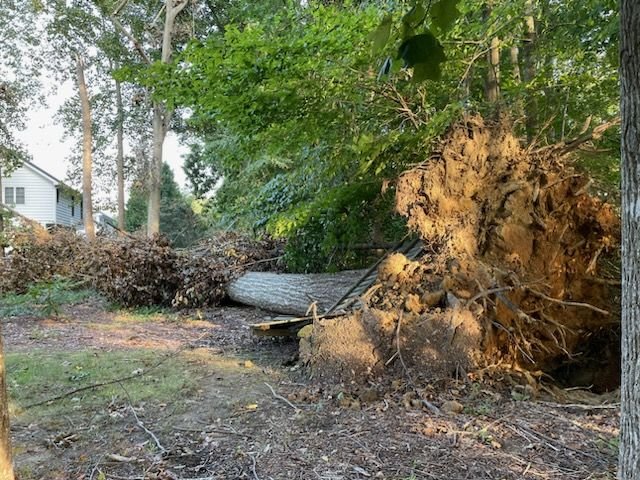
When a whole tree tips over in saturated ground, the root plate lifts a slab of earth with it. That slab is heavy, it is unstable, and it will drop back into the hole when the weight of the trunk comes off it.
Which means the order of cuts matters. Cut the trunk in the wrong place first and the root plate slams back down, taking whatever is near it with it.
It also means the hole is a hazard on its own. Fence it off or keep everyone away from it until the crew gets there, especially in the dark.
Whose tree, whose fence, whose problem
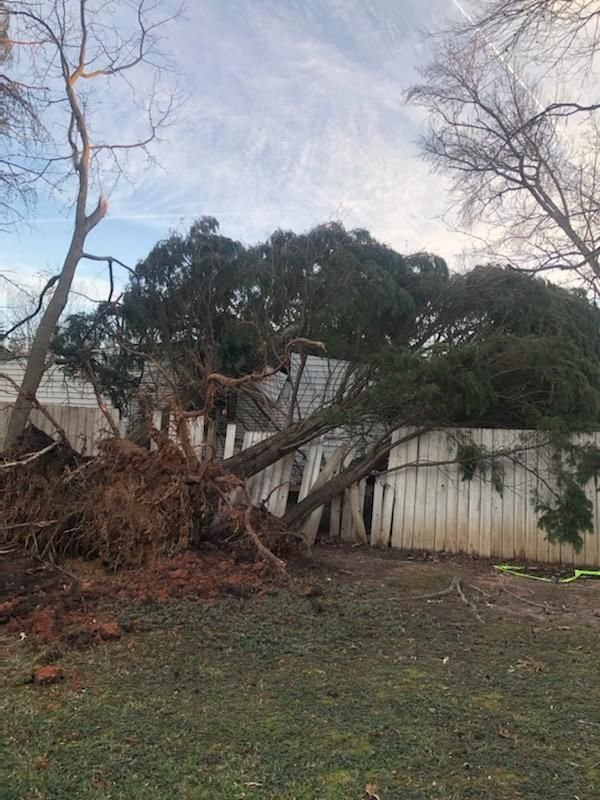
The question everybody asks after a storm is who pays when a tree crosses a property line, and the honest answer is that it depends on things we cannot see from your driveway.
As a general rule across most of the country, damage is handled by the insurer of the property the tree landed on, not the property it grew on. Fault only tends to enter the picture where a tree was already dead or obviously hazardous and the owner had been told about it.
None of that is legal advice, and we are not qualified to give any. Your carrier and, if it gets difficult, an attorney are the people to ask.
What we can do is get the tree off, document what we found, and give you an invoice you can hand to an adjuster. We do not bill insurers directly and we do not negotiate claims.
What gets cleaned up
The same as any other job. Wood out on the grapple truck, brush through the chipper, driveway blown off, and the grass raked. After a storm that usually means clearing debris that was never ours to start with, and that is fine.
If the tree took a fence with it, we cut and clear it. We do not rebuild fences, roofs, or sheds. That is a contractor's job, and having the tree gone is what lets them start.
What actually changes the price.
Storm work is priced on site like everything else, and no reputable company can quote a tree on a house sight unseen.
What it is resting on
A tree lying in the open yard is a straightforward job. The same tree across a roof, a fence, or a car has to be taken off in pieces, in an order that does not make the damage worse.
Whether it is still under load
Hung-up trees, bent-over saplings, and uprooted plates are all storing energy. Releasing that safely takes rigging and time.
Access, again
Storms do not care whether the truck can get to the back yard. Sometimes the answer is a crane in the street, and that is a different day's work.
Beware the truck that shows up uninvited after a storm. Bad weather brings out crews who follow the damage, knock on doors, ask for cash up front, and are three counties away by the time anything goes wrong. Ask anybody who knocks for proof of insurance before they touch a saw. Ours goes out with the estimate without being asked.
Where we work
Greensboro is home, and the yard is at 4262 Pleasant Garden Rd. The crews cover the wider Triad: High Point, Winston-Salem, Jamestown, Kernersville, Summerfield, Oak Ridge, Pleasant Garden, Archdale, Thomasville, Gibsonville, Whitsett, Browns Summit, Colfax, Stokesdale, McLeansville, Randleman, and Julian.
Storm calls are taken seven days a week. If a tree is on your house or across your driveway right now, call (336) 908-7990 rather than waiting on a callback.
What customers said about work like this
Taken from the company's Google profile, word for word.
We have several very tall pines on our farm that eventually would have fallen on fences and buildings. They came out and cut the trees down in a day, then returned the following day to grind the stumps down. I wished I had taken them up on the offer to keep the pine chips from the trees so we could use them for the barns. They cleaned up the area nicely.
We had a large oak tree removed from our property with the help of the Tiad Tree Removal Services. The tree was close to our house, the fence and was surrounded by the concrete all around the tree. The job was done very professionally, the crew worked very efficiently and cleaned everything up after the job was completed. There was no damage to the fence or the concrete. We are very pleased with the work. The price was very reasonable. We would recommend this service to anybody.
Even though the weather was in the teens, the crew showed up on time, worked non stop till the job was finished and cleaned the entire work area. I was concerned about my neighbors yard being damaged by the heavy branches but they painstakingly tied off each branch and gently lowered them to the ground. I would highly recommend Triad Tree Service to anyone who wants professional service at a fair price!
Storm damage questions we get every week.
A tree just fell on my house. What do I do first?
Should I call the fire department if a tree falls on my house?
Will insurance pay for storm damage tree removal?
My neighbor's tree fell on my property. Who is responsible?
What counts as an emergency versus a normal job?
There is a tree leaning into another tree. Can I pull it down myself?
Do you work at night or on weekends?
Do you fix the fence or the roof afterwards?
The rest of what we do.
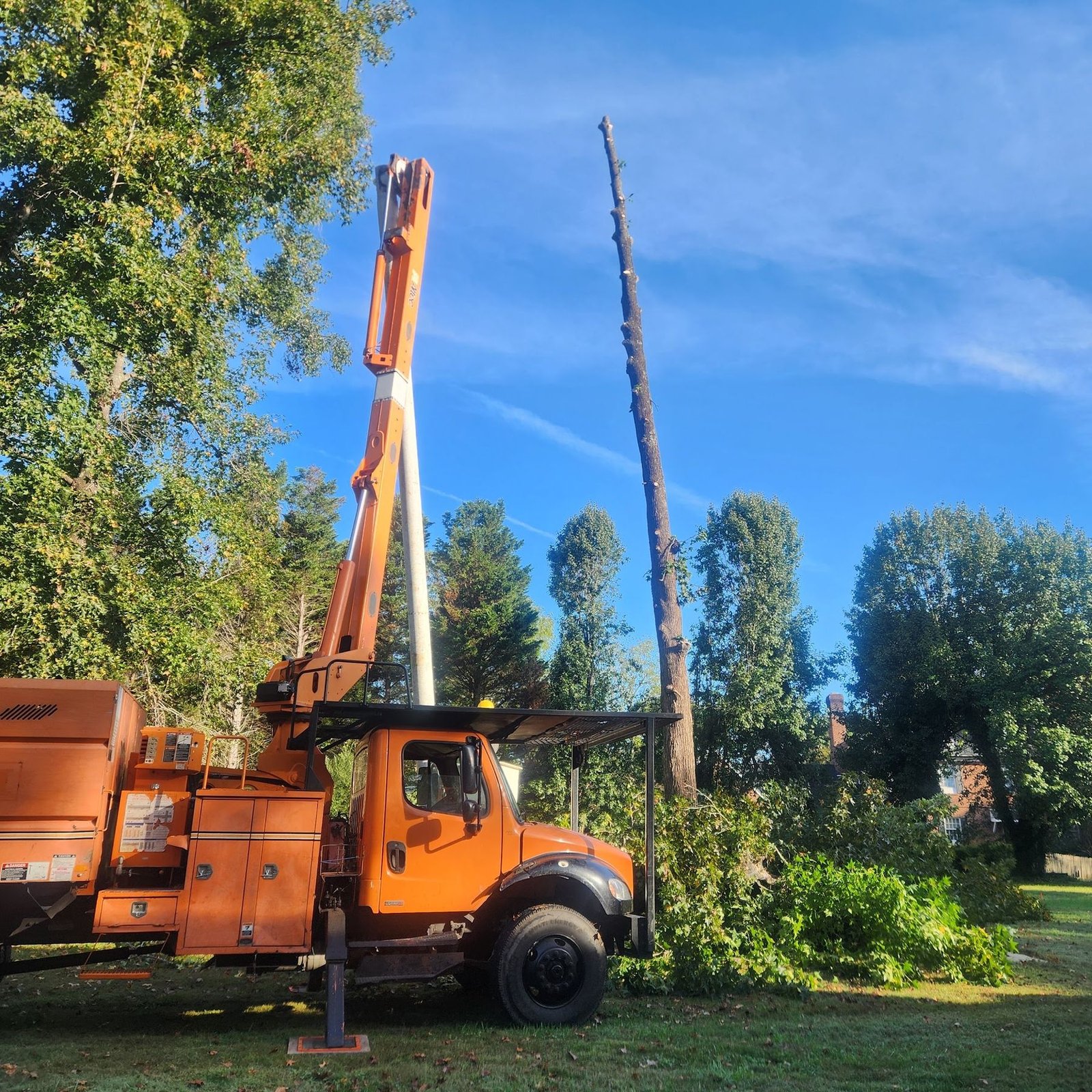
Tree Removal
Large and hazardous trees taken down in sections before they become a storm call.
Read more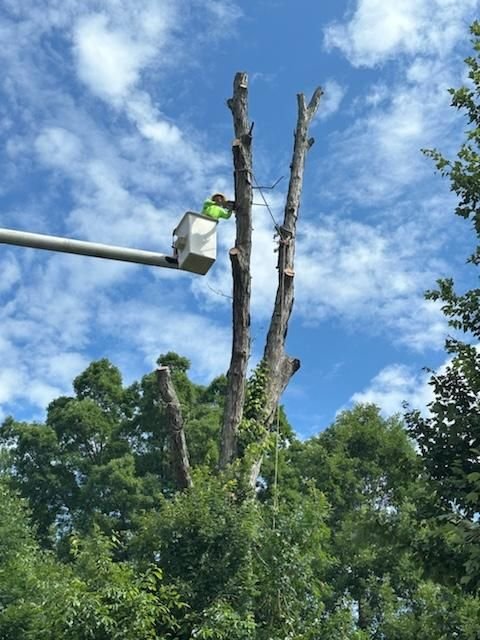
Trimming & Limbing
Deadwood out and canopies thinned so the wind has somewhere to go.
Read more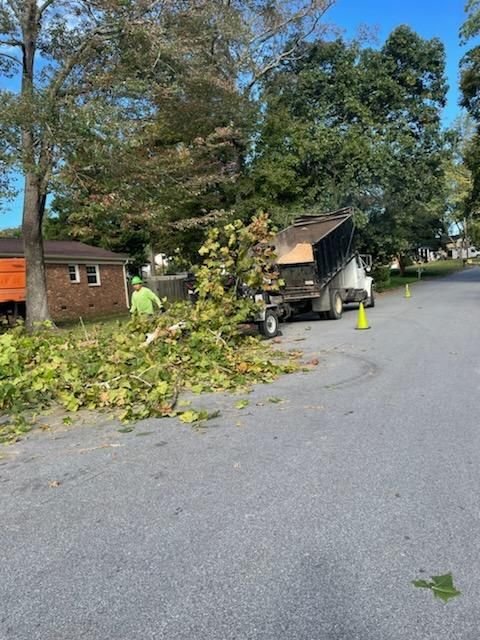
Hauling & Chipping
Wood out on the grapple truck and brush through the chipper, including somebody else's mess.
Read more